Making Barth Useful? American Reception and the Critique of Religion
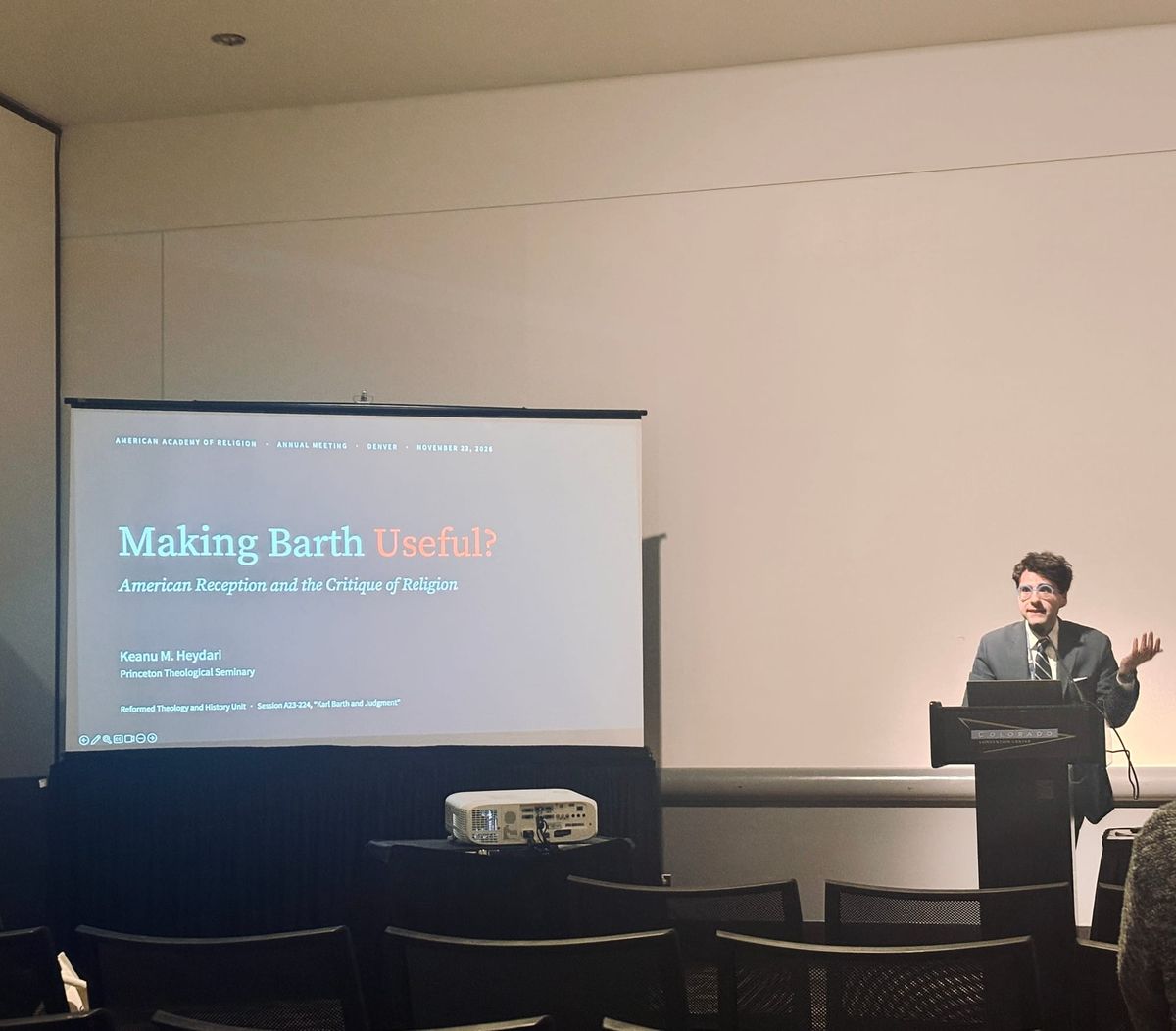
Paper presented by Keanu M. Heydari at the Annual Meeting of the American Academy of Religion, Reformed Theology and History Unit, Session A23-224, “Karl Barth and Judgment,” Denver, Colorado (November 23, 2026).
Prologue
Hello everyone, I am absolutely delighted and honored to be here today as we have gathered to discuss a set of very salient themes, both in Barth studies and in the context of the United States at large. I thank Dr. Sara Mannen for presiding, I thank my fellow panelists, and I thank you all for being in attendance today.
I. The Phenomenon and the Question
This past summer, the General Assembly of the Presbyterian Church (U.S.A.) repudiated Christian nationalism twice. By a vote of 458 to 15, it proposed an amendment to the church’s constitution. By a vote of 459 to 25, it adopted a policy against white Christian nationalism.[1] The Theological Declaration of Barmen was cited in support, and, it appears, the citation was routine. Barmen was written in 1934 against the German Christian movement in Nazi Germany. It has stood in the Presbyterian Book of Confessions since 1967. In 2018, the statement “Reclaiming Jesus” took the same form, with six affirmations and a rejection attached to each.[2] Barmen is now the mainline church’s standard text against the nationalist right. It is largely Karl Barth’s work, and to cite it is to cite him. Perhaps it is a troubling reflection on our current state of affairs in the United States, but I feel it is imperative to say that I accept the substance of the church’s opposition to Christian nationalism. My subject today pertains to the citation of the Theological Declaration.
What does the citation do for the church that makes it? Barth provides a word for my answer. Writing about natural theology, he sees a danger to the gospel greater than rejection. The danger is acceptance. The hearer takes the gospel in hand and becomes its owner, and it is then respectable and harmless. Barth calls this “the absorbing and domesticating of revelation.”[3] A theology can be accepted the same way. Very provisionally, my thesis is that American Protestants have domesticated Barth’s theology three times. Reinhold Niebuhr conscripted Barth’s attack on liberal optimism. Stanley Hauerwas corrected Niebuhr and recruited Barth for the church’s witness. The third domestication is the mainline’s, and it is currently under way. Their mistakes are unequal, but their formal error is perhaps the same. Each values Barth when he authorizes something.
The theme of this session is judgment, so I put my question in its terms. Who is judged when the church cites Barth? The usual answer, it appears, is the Christian nationalist. Barth’s answer, I will argue, is that judgment falls first on the church that pronounces it. I speak as a Presbyterian deacon and an inquirer for the ministry of Word and Sacrament. The Assembly spoke for my church and for me. Even-handedness between my church and the nationalists has no part in what follows. I am instead asking what my church does with being right. Most of my time goes to the reception history: Niebuhr and Hauerwas first, then the mainline. From there, I turn to paragraph 17 of the Church Dogmatics, where Barth calls religion unbelief. I end with religion as such, judged and justified in one act.
II. The Reception History
A. Niebuhr
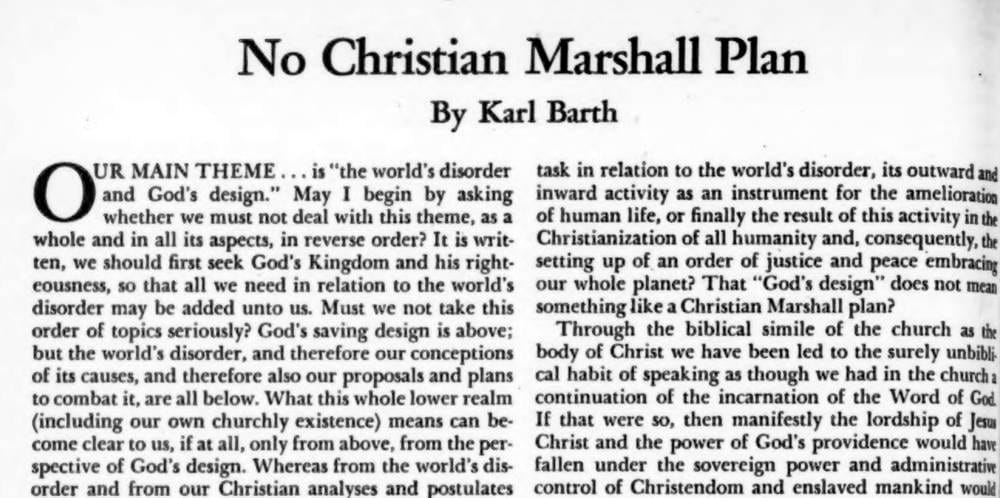
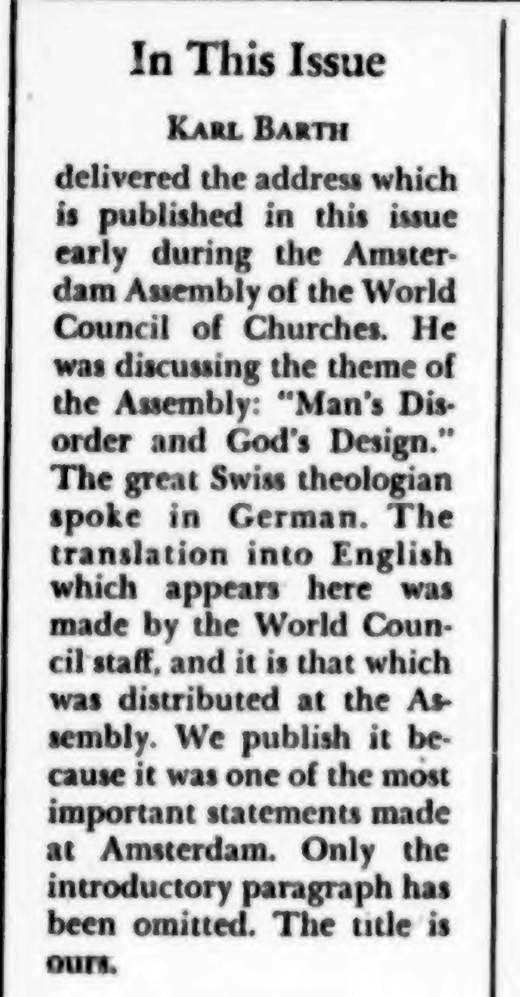
Let us begin with Reinhold Niebuhr and what he took from Barth. In 1928, he welcomed Barth’s note of tragedy as medicine against the optimism of liberal theology.[4] By 1934, he could speak of a neo-orthodoxy that Barth had created, and in 1956 he counted himself among those who stood in that tradition.[5] Barth came to America as a blow against optimism, and Niebuhr delivered it. The Christian Century shows how far the adoption went. In 1948, Barth addressed the first assembly of the World Council of Churches at Amsterdam, and Niebuhr answered him. The Century printed the answer six weeks before it printed the address. Its editors called Niebuhr’s piece the most important and hopeful word in years from the so-called neo-orthodox wing of American Protestantism. Barth’s address ran in December under a headline the editors wrote, with a note that said so: “The title is ours.”[6]
What Niebuhr declined was any path from Barth’s theology to Barth’s political judgment. He agreed with Barth about Hitler and credited Barth’s stand to sources outside his theology. In 1938, Barth urged the Czechs to fight, and Niebuhr called it the abandonment of Barth’s thesis. A year later, Niebuhr found that Barth had arrived, unconfessed, at the principles of Niebuhr’s Christian socialists.[7] He granted in 1948 that this theology breeds heroes once tyranny is full blown, and added that it has nothing to tell a statesman.[8] After the war, Barth refused the sequel, as it were. He would not say against Moscow what he had said against Berlin. Niebuhr listed him in 1953 among the fellow travelers of Europe. And in 1957, he traced even the old resistance to Barth’s personal experience of tyranny.[9] That is the conscription: Niebuhr kept the blow against optimism and discharged the theologian.
That 1957 article asks why Barth is silent on Hungary. It states Niebuhr’s criterion outright. Barth, he says, will scorn the idea of judging a theology by its political fruits. Niebuhr judges it so anyway, and cites the Gospel: “By their fruits shall ye know them.”[10] Niebuhr deserves a fair hearing here. He refused to make theology the chaplain of the American cause. In 1949, he mocked the confidence that God is our ally against Communism. In the same breath he thanked Barth for freeing the faith from the idolatries of the day.[11] What he asked of theology was discriminating political judgment, the kind a statesman can use. The error then is in the criterion itself. A theology measured by the political wisdom it yields is measured by someone who already knows what wisdom is. In 1957, Niebuhr knew, and by that measure, Barth’s theology had failed.
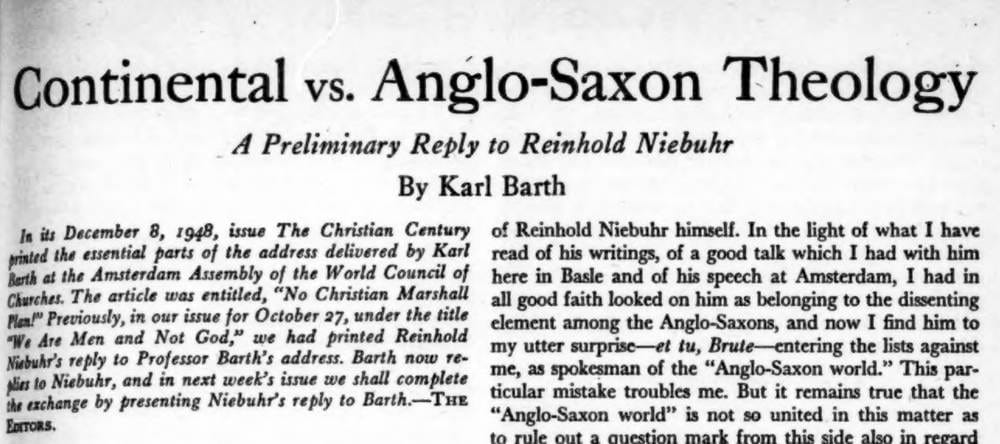
Barth answered twice. In 1949, he replied in the Century. The Amsterdam papers, he wrote, tried to climb from the world’s disorder to God’s plan. On that path, nothing prevents us from finding our own diagnosis and our own cure in the plan of God.[12] That is the formal error in Barth’s own words, charged to the theology Niebuhr spoke for. The second answer came in 1958, in a letter to an East German pastor. Niebuhr’s Hungary question, he wrote, was dishonest, a trap meant to force him into anticommunism or expose him as a secret pro-Communist. And he could not speak his mind about the East without being “praised and used” by the Western anticommunists he most distrusted.[13] Barth knew he was being made useful, and he said so.
B. Hauerwas
Half a century later, Stanley Hauerwas reopened the case. His Gifford Lectures, published in 2001 as With the Grain of the Universe, argue that Niebuhr never left liberalism. The neo-orthodox label was misleading. Niebuhr stayed inside the assumptions of Protestant liberalism, and his own Gifford Lectures amount to William James’s account of religious experience in Christian dress.[14] Against Niebuhr, Hauerwas set Barth. He declared Barth “the great natural theologian of the Gifford Lectures,” and he read the Church Dogmatics as a sustained act of witness. Barth is the witness Niebuhr could not be.[15] The correction is perhaps right, and my own account of Niebuhr depends on it in some ways. Hauerwas saw that Niebuhr had kept a Barthian manner and declined the Barthian matter. He undid the conscription. But the second domestication begins at just this point. It is more difficult to see, because it is done in Barth’s defense.
Hauerwas tells us himself where Barth disappoints him. The question, he says, is whether Barth is “sufficiently catholic.”[16] Barth grants that the gospel constitutes the church. He will not grant that the church is constitutive of the gospel’s proclamation, or that through the church we share God’s care for the world. Later the charge sharpens. Barth cannot say why knowing the world truly should require the church, and he leaves the world far too much to itself.[17] The sticking point is a passage in the Church Dogmatics. The world, Barth writes, would be lost without Jesus Christ, and it would not necessarily be lost without the church. Hauerwas quotes the passage and asks what difference the church then makes.[18] The recruitment has this shape. Barth is enlisted as the church’s great witness. Where he refuses to let the church’s witness carry the truth of the gospel, he is corrected.
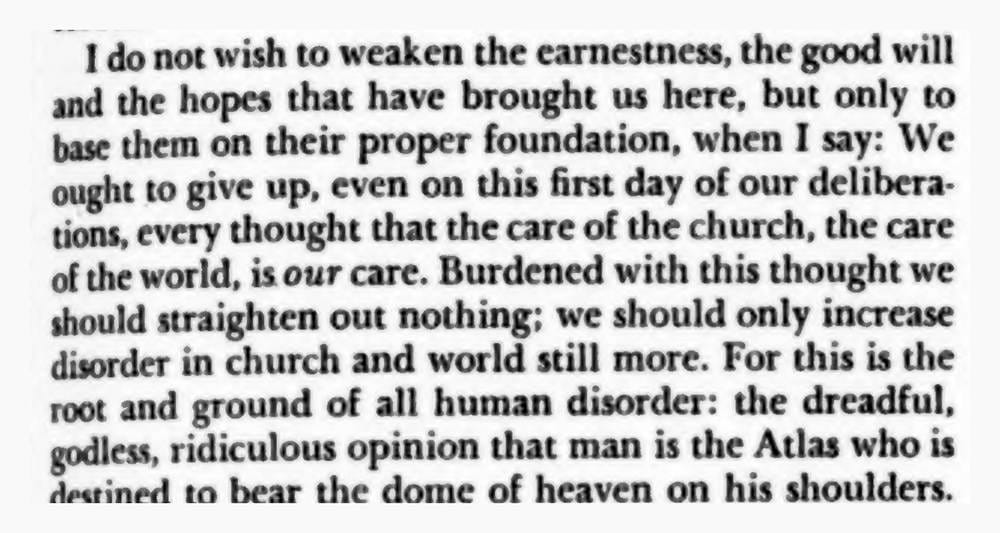
Let us set Hauerwas beside Niebuhr. The church’s ongoing task, Hauerwas writes, is to produce truthful witnesses, known by their fruits. He attributes to Barth the view that no account of Christian truth is possible without the distinctive Christian life.[19] Niebuhr judged a theology by its political fruits. Hauerwas keeps the criterion and changes the fruit, from political wisdom to the lives of witnesses. There are shared complaints as well. Both men find Barth’s care for the world too thin, and both object that he leaves it alone.[20] Barth had answered at Amsterdam. We should give up, he said, every thought that “the care of the church, the care of the world, is our care.” He refused to call the church a continuation of the incarnation.[21] In 1946, he had written that the church in politics does not fight for its own position.[22] The church that needs Barth to underwrite its witness receives the answer the statesman received.
C. The Mainline Phase
The third domestication is the mainline’s own, and it is older than it looks. In 1938, The Christian Century took up the new theologians in an editorial. Dialectic, it said, is “the very essence of liberalism,” and the dialectical theologians were saying what liberals had once told the orthodox.[23] Barth was welcome as liberalism’s latest correction of itself. A year earlier, John Mackay had opened his presidency at Princeton Seminary by commending Barth’s theology for its strength to resist the new totalitarian faiths.[24] The two halves of the present use were in place before the war. Barth was our own tradition at its best, and Barth was resistance. In 1967, the United Presbyterian Church adopted a Book of Confessions with Barmen in it. Beside Barmen stood the Confession of 1967, written at the high tide of American neo-orthodoxy.[25] Barmen became an American confession when America had already made Barth its own.
David Congdon has shown what this confession does in American hands. Writing in The Presbyterian Outlook in 2024, he called the mainline reading of Barmen as a stand against Nazism a “mythology.”[26] My church’s new policy, one could argue, repeats it: Barmen, it says, was written in the face of Nazi racism and nationalism.[27] German history bears Congdon out. Wolfgang Gerlach showed from the documents that the Confessing Church defended its doctrine and its independence, and that Jewish people as such found advocates only among isolated individuals.[28] A confession of the church’s own freedom serves the right as readily as the left, and during the COVID-19 pandemic, the right cited Barmen against public health orders.[29] Congdon has also examined my own side. When the Christian left calls Christian nationalism a heresy, he argues, it practices the hunting of heretics that made Christian nationalism possible in the first place.[30] I accept these findings and begin from them. Together they establish that Barmen, and Barth with it, is available to anyone. They leave open why.
On Saturday morning, here in Denver, Congdon gave an answer of his own. His paper is unpublished, so I paraphrase. Part of the fault, he argued, lies in Barth himself. A No spoken from the Word alone, above the parties, can be taken over by any party. He asked instead for a Yes to a definite politics.[31] I take the warning and the Yes seriously, and both return at the end of this paper. Here I add a second answer, from the side of Barth’s readers. It lies in what they have wanted from him. In the mid-1930s, Niebuhr asked for criteria by which to judge political movements.[32] Keith Ward, a recent critic of paragraph 17, looks at the liberals who backed Hitler and concludes that Christianity needed to be “more, not less, liberal.” That was already the Century’s doctrine in 1938.[33] The mainline prescribes the true faith against heresy, or in my church’s phrase, against theological error.[34] The contents differ but the form holds. Each asks Barth, or his replacement, to authorize something. I assert this provocation, that this demand is what Barth meant by “religion.”
III. Paragraph 17
Paragraph 17 reached English readers in 1956, after most of Niebuhr’s essays on Barth, under the title “The Revelation of God as the Abolition of Religion.” The translation is itself an act of reception. Barth’s word is Aufhebung, which can mean that a thing is cancelled and can mean that it is kept and lifted up. He uses both senses, and the English needs nine words for his one.[35] I begin with the cancelling. Religion, Barth says, is unbelief, and he means religion even at its best. Faith accepts a gift, and religion takes. In religion, Barth writes, human beings do not believe. A paper about citation should fear his next sentence: “If he did, he would listen; but in religion he talks.”[36] This is no negative verdict on the worth of religion, he insists, and it strikes Christians first.[37] It is God’s judgment, and the church hears it as a judgment on itself.
The first section of the paragraph tells a history of Protestant theology and draws a warning from it. Barth published it in 1938. He traces how revelation and religion changed places in Protestant thought, until religion became the measure of revelation. He finds the beginning of that exchange in the orthodox teachers of the seventeenth century, long before the liberals. Then he writes that “we are defenceless against the ‘German Christians’ of our own time” unless we can enter a reasoned protest against the turn those teachers took.[38] To fight them point by point, out of conservatism, is to be lost, whatever our intentions and whatever our victories in detail. He calls that conservatism fear. We should apply the warning here. A church can oppose Christian nationalism for its politics and still share its premise, which is that faith is worth what it underwrites. On Barth’s account, that church is defenseless, and its victories change nothing.
The third section tells the history of Christianity as a history of self-commendation, first by its superior religion and then by its alliance with power. In the modern age, its third stage, it had to earn its keep. Barth’s word for it is “useful” (nützlich): a force for education and order, tolerated in the service of Western man’s glory.[39] In that stage the truth of Christianity passes from hand to hand, liberal in one and national in the next. He expects no better from a fourth stage or a fifth.[40] He lists what the church leans on for assurance: its institutions and theological systems, the changed lives of its members, and its power to change the world. The last two are the fruits Hauerwas and Niebuhr demanded. All of them, he says, are facts that themselves need justification.[41] A theology, as it were, is indeed on that list. A useful Barth is the third stage applied to Barth.
Barth left a test for confession: in 1948, Emil Brunner asked why he would not confess against Communism as he had against Hitler. Barth answered that year and the next: the church confesses when it must defend itself against a temptation. National Socialism was one, and it worked inside the church. He asked: “for which of us is Communism a temptation?”[42] In a real crisis, he said, Barmen’s first article will serve better than knowing that totalitarianism is objectionable.[43] Put both to my church. Barth honored the fifth article. His 1946 essay on church and state rests on it, and he wished the Confessing Church had heeded it sooner. He drew on its affirmation, in which the church trusts and obeys the Word. My church drew on its rejection. The Assembly’s texts quote the sentence against the totalitarian state twice, and both times the quotation ends before the clause on the church’s vocation. What is left is Brunner’s knowledge that totalitarianism is objectionable. The first article is cited nowhere.[44] The amendment’s own rationale reports that 54 percent of mainline Protestants favor declaring the country a Christian nation.[45] The temptation sits in our own pews. On the Assembly floor, the vote was 458 to 15. The committee that added the second Barmen quotation to the policy called the condemnation a faithful application of what the church already believes.[46] What tempts an assembly like that is using the gospel to confirm what it already is. Paragraph 17 has a word for that use: religion.
IV. The Ending
I have now turned Barth’s paragraph on my own church, and the paragraph has something to say about that. Religion’s criticism of itself, Barth says, belongs to the life of religion. The mystic and the atheist turn against religion and remain inside it, and the purer their protest, the less it threatens. The real crisis comes only from outside “the magic circle of religion.”[47] A paper like this one stands inside the circle, and so does its author. Niebuhr warned that a theology of judgment ends in complacency toward injustice, and Congdon warned on Saturday that critique alone can be taken over by what it criticizes.[48] Ward, no friend of Barth, observes that one can flaunt spiritual poverty as well as spiritual insight.[49] I grant it all. The critic of the church’s self-assurance has found one more way to be assured.
Barth’s paragraph goes further, and this paper must follow. Here the title’s word returns in its other sense: the same translation now has religion exalted.[50] The last section turns on one sentence: “There is a true religion: just as there are justified sinners.”[51] The grace that makes a religion true is the same revelation that judges it. No form of Christianity owns that truth, the Reformed included. Truth of this kind is an event, as Barth told Niebuhr in 1949.[52] So the church is free to decide and to speak, and I offer no counsel of silence. In 1952, Barth described the Christian who decides in politics: he puts himself in question before God’s judgment and must still make up his mind.[53] At Amsterdam, he asked the churches for decisions as signs of hope and warned them against programs.[54] My church should go on opposing Christian nationalism, case by case. The Assembly found one case at home, the flags that proudly stand in many of our sanctuaries.[55]
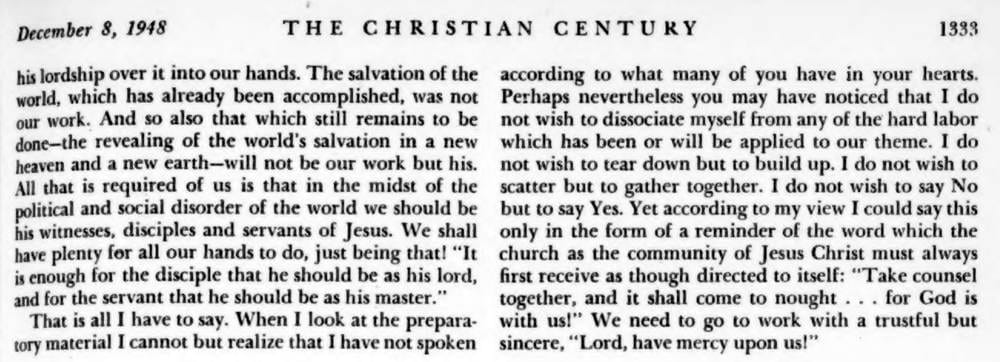
At Amsterdam, Barth wished to say Yes. He could say it only by recalling the word the church must first receive as directed to itself.[56] Barmen stands under that word. In 1933, Barth advised Bonhoeffer to wait for a more central conflict than the Aryan paragraph, and Barmen said nothing about the Jewish people.[57] Barth himself charged the Confessing Church in 1935 with speaking for no one except itself.[58] After 1945, that church became German Protestantism’s claim to have resisted, and Barmen became a credential.[59] Repentance, I argue, can become one such credential, too. In this summer’s policy, my church repents of its historical complicity. Barth calls such confession a symptom of the true religion, and symptoms, he says, do not in fact demonstrate it.[60] The study guide issued with the policy has us pray, “We do not need to be right.”[61] Does the confidence with which we cite Barth show that we have not yet heard him? His Amsterdam address ended in a prayer: “Lord, have mercy upon us!”
Presbyterian Church (U.S.A.), 227th General Assembly (2026), item RUS-01, “On Taking Action to Repudiate Christian Nationalism and Affirm Our Faith Commitments,” approved as amended, 458–15, PC-Biz, https://myga.pc-biz.org/search/3001414; item RUS-07, “Standing Against White Christian Nationalism Recommendations and Rationale,” approved 459–25, PC-Biz, https://myga.pc-biz.org/search/3001498. John A. Bolt reported the first vote as 458–18 (“PC(USA) Labels White Christian Nationalism ‘Theological Error,’” Presbyterian Outlook, July 1, 2026, https://pres-outlook.org/2026/07/pcusa-labels-white-christian-nationalism-theological-error/); the record gives 458–15, as does Office of the General Assembly, Proposed Amendments to the Constitution (Presbyterian Church (U.S.A.), 2026), 9, https://pcusa.org/resource/proposed-amendments-constitution. For the citations of Barmen, see nn. 27 and 44. ↩︎
“Reclaiming Jesus: A Confession of Faith in a Time of Crisis,” 2018, http://www.reclaimingjesus.org/; Episcopal News Service, “Presiding Bishop, Others Begin Campaign to ‘Reclaim Jesus’ in US Culture,” March 22, 2018, https://episcopalnewsservice.org/2018/03/22/presiding-bishop-others-begin-campaign-to-reclaim-jesus-in-us-culture/. ↩︎
Karl Barth, Church Dogmatics, vol. II/1, ed. G. W. Bromiley and T. F. Torrance (T&T Clark, 1957), 141, quoted in Stanley Hauerwas, With the Grain of the Universe: The Church’s Witness and Natural Theology (Brazos Press, 2001), 198n53. ↩︎
Reinhold Niebuhr, “Barth—Apostle of the Absolute” (1928), in Essays in Applied Christianity, ed. D. B. Robertson (Meridian Books, 1959), 143–44. ↩︎
Reinhold Niebuhr, “Barthianism and Political Reaction” (1934), in Essays in Applied Christianity, 151; Reinhold Niebuhr, “Literalism, Individualism, and Billy Graham” (1956), in Essays in Applied Christianity, 125. ↩︎
Reinhold Niebuhr, “We Are Men and Not God,” Christian Century 65, no. 43 (October 27, 1948): 1138–40; Karl Barth, “No Christian Marshall Plan,” Christian Century 65, no. 49 (December 8, 1948): 1330–33; “In This Issue,” Christian Century 65, no. 43 (October 27, 1948): 1130; “In This Issue,” Christian Century 65, no. 49 (December 8, 1948): 1322. ↩︎
Reinhold Niebuhr, “Karl Barth and Democracy” (1938), in Essays in Applied Christianity, 164; Reinhold Niebuhr, “Karl Barth on Politics” (1939), in Essays in Applied Christianity, 165–67. ↩︎
Reinhold Niebuhr, “We Are Men and Not God” (1948), in Essays in Applied Christianity, 172. ↩︎
Reinhold Niebuhr, “Communism and the Clergy” (1953), in Essays in Applied Christianity, 120–21; Reinhold Niebuhr, “Why Is Barth Silent on Hungary?” (1957), in Essays in Applied Christianity, 184. ↩︎
Niebuhr, “Why Is Barth Silent on Hungary?,” 184. ↩︎
Reinhold Niebuhr, “An Answer to Karl Barth” (1949), in Essays in Applied Christianity, 178. ↩︎
Karl Barth, “Continental vs. Anglo-Saxon Theology: A Preliminary Reply to Reinhold Niebuhr,” Christian Century 66, no. 7 (February 16, 1949): 201–2. ↩︎
Karl Barth, “Letter to a Pastor in the German Democratic Republic,” in Karl Barth and Johannes Hamel, How to Serve God in a Marxist Land (Association Press, 1959), 45–46, 49. ↩︎
Hauerwas, With the Grain of the Universe, 87. ↩︎
Hauerwas, With the Grain of the Universe, 39, 141–204. ↩︎
Hauerwas, With the Grain of the Universe, 145. ↩︎
Hauerwas, With the Grain of the Universe, 192, 202–3. ↩︎
Karl Barth, Church Dogmatics, vol. IV/3.2, ed. G. W. Bromiley and T. F. Torrance (T&T Clark, 1962), 826, quoted in Hauerwas, With the Grain of the Universe, 193.↩︎
Hauerwas, With the Grain of the Universe, 200. ↩︎
Niebuhr, “We Are Men and Not God,” in Essays in Applied Christianity, 169–74; Hauerwas, With the Grain of the Universe, 145, 202–3. ↩︎
Barth, “No Christian Marshall Plan,” 1330–31. ↩︎
Karl Barth, “The Christian Community and the Civil Community” (1946), in Against the Stream: Shorter Post-War Writings, 1946–52, ed. Ronald Gregor Smith (SCM Press, 1954), 29–30. ↩︎
“Arrested Liberalism” (1938), in The Christian Century Reader: Representative Articles, Editorials, and Poems Selected from More Than Fifty Years of “The Christian Century,” ed. Harold E. Fey and Margaret Frakes (Association Press, 1962), 109. ↩︎
David W. Congdon, Who Is a True Christian? Contesting Religious Identity in American Culture (Cambridge University Press, 2024), 108–10. ↩︎
Congdon, Who Is a True Christian?, 124–25; on the adoption in 1967, Presbyterian Historical Society, “Where Did the Confession of 1967 Come From?,” February 12, 2016, https://pcusa.org/news-storytelling/blogs/historical-society-blog/where-did-confession-1967-come. ↩︎
David W. Congdon, “Teaching Reformed Theology in Trump’s America: The Barmen Declaration and the Far-Right Evangelical Culture War,” Presbyterian Outlook, July 17, 2024, https://pres-outlook.org/2024/07/teaching-reformed-theology-in-trumps-america-the-barmen-declaration-and-the-far-right-evangelical-culture-war/. ↩︎
Advisory Committee on Social Witness Policy, “Standing Against White Christian Nationalism,” policy text uploaded with Presbyterian Church (U.S.A.), RUS-07 (see n. 1), under “Reformed Biblical and Theological Bases to Reject White Christian Nationalism.” The policy calls Barmen “written in the face of the deep racism and nationalism of Nazi Germany.” ↩︎
Wolfgang Gerlach, And the Witnesses Were Silent: The Confessing Church and the Persecution of the Jews, trans. and ed. Victoria J. Barnett (University of Nebraska Press, 2000), vii–viii. ↩︎
Congdon, “Teaching Reformed Theology in Trump’s America”; Grace Community Church elders, “Christ, Not Caesar, Is Head of the Church,” July 24, 2020, https://gracechurch.org/news/posts/1988; Tim Cantrell, “When to Disobey: A Theology of Resistance for Reluctant Protestants,” February 2021, https://www.gracechurch.org/outreach/posts/2127. The appeal to Barmen is Cantrell’s. ↩︎
David W. Congdon, “Orthodoxy, Not Heresy, Is the Root Problem of Christian Nationalism,” Presbyterian Outlook, January 10, 2025, https://pres-outlook.org/2025/01/orthodoxy-not-heresy-is-the-root-problem-of-christian-nationalism/. ↩︎
David W. Congdon, “The Politics of God’s Yes: Karl Barth in Conversation with American Christian Nationalism” (paper presented at the Karl Barth Society of North America session, American Academy of Religion Annual Meeting, Denver, CO, November 21, 2026), posted November 24, 2026, https://dwcongdon.substack.com/p/the-politics-of-gods-yes-karl-barth. Congdon’s Yes is to social democracy, and he draws it from the socialist writings of the young Barth. ↩︎
Niebuhr, “Barthianism and Political Reaction,” 151–56; Reinhold Niebuhr, “Marx, Barth, and Israel’s Prophets” (1935), in Essays in Applied Christianity, 162. ↩︎
Keith Ward, Karl Barth on Religion: A Critique (Cambridge University Press, 2025), 53; “Arrested Liberalism,” 107, 109–10. ↩︎
Congdon, “Orthodoxy, Not Heresy”; Presbyterian Church (U.S.A.), RUS-01 (see n. 1), proposed Book of Order F-1.0305, “Faithful Witness in Public Life”; Bolt, “PC(USA) Labels White Christian Nationalism.” ↩︎
Karl Barth, Church Dogmatics, vol. I/2, ed. G. W. Bromiley and T. F. Torrance, trans. G. T. Thomson and Harold Knight (T&T Clark, 1956), §17, 280–361; Karl Barth, Die kirchliche Dogmatik, vol. I/2 (Verlag der Evangelischen Buchhandlung, 1938), §17, 304–97. The renderings are “abolition” or “abolishing,” “sublimated,” “dispensable,” “removed,” “displace,” “suppress,” “abrogation,” “exalted,” and “done away.” ↩︎
Barth, Church Dogmatics, vol. I/2, 299–300, 302. ↩︎
Barth, Church Dogmatics, vol. I/2, 300. ↩︎
Barth, Church Dogmatics, vol. I/2, 284–92; the quotation is on 292. The paraphrase of its second clause follows the German (begründete Verwahrung einzulegen), where the translation has “guard against”; see Die kirchliche Dogmatik, vol. I/2, §17.1. ↩︎
Barth, Church Dogmatics, vol. I/2, 333–35. ↩︎
Barth, Church Dogmatics, vol. I/2, 336, 338. ↩︎
Barth, Church Dogmatics, vol. I/2, 357. ↩︎
Karl Barth, “The Church Between East and West” (1949), in Against the Stream, 142. ↩︎
Karl Barth, reply to Emil Brunner’s open letter (1948), in Against the Stream, 114–17; the sentence on Barmen’s first article is on 117. ↩︎
Presbyterian Church (U.S.A.), RUS-07 (see n. 1). The policy quotes the first rejection of Barmen’s fifth thesis (Barth’s “article”; Book of Confessions, 8.23) in the passage cited in n. 27 and ends the quotation before the clause on the church’s vocation. The Assembly’s tenth recommendation quotes the same sentence as 8.17, ends at the same point, and omits the words on the State’s special commission. The rationale of RUS-01 cites Barmen without a paragraph number. Two committees, in their advice and counsel, also cite 8.18, the rejection in the third thesis. The first thesis (8.10–8.12) is cited in neither record. Barth cites the fifth thesis, always from its affirmation, in “The Christian Community and the Civil Community,” in Against the Stream, 17, 21, 22, 26, 50. ↩︎
Presbyterian Church (U.S.A.), RUS-01 (see n. 1), rationale, citing Pew Research Center, Decline of Christianity in the U.S. Has Slowed, May Have Leveled Off: Findings from the 2023–24 Religious Landscape Study (February 26, 2025), 292, https://www.pewresearch.org/wp-content/uploads/sites/20/2025/02/PR_2025.02.26_religious-landscape-study_report.pdf. ↩︎
Advocacy Committee for LGBTQIA+ Equity, advice and counsel on RUS-07 (see n. 1). The committee says that the confessions ground the condemnation “not as a new claim, but as a faithful application of what the Church already believes.” ↩︎
Barth, Church Dogmatics, vol. I/2, 314–15, 324–25; the quotation is on 324. ↩︎
Reinhold Niebuhr, “Barthianism and the Kingdom” (1931), in Essays in Applied Christianity, 148–50; Niebuhr, “Barthianism and Political Reaction,” 153–54; Congdon, “The Politics of God’s Yes.” ↩︎
Ward, Karl Barth on Religion, 141. ↩︎
Barth, Church Dogmatics, vol. I/2, 280, 326. ↩︎
Barth, Church Dogmatics, vol. I/2, 326. ↩︎
Barth, Church Dogmatics, vol. I/2, 326, 342, 344; Barth, “Continental vs. Anglo-Saxon Theology,” 203. ↩︎
Karl Barth, “Political Decisions in the Unity of the Faith” (1952), in Against the Stream, 156. ↩︎
Barth, “No Christian Marshall Plan,” 1332. ↩︎
Presbyterian Church (U.S.A.), RUS-07 (see n. 1), recommendation 7. ↩︎
Barth, “No Christian Marshall Plan,” 1333. ↩︎
Gerlach, And the Witnesses Were Silent, 26–27, 31–32, 73–75. ↩︎
Gary Dorrien, The Barthian Revolt in Modern Theology: Theology Without Weapons (Westminster John Knox Press, 2000), 143, quoting Barth to Hermann Albert Hesse, June 30, 1935; Gerlach, And the Witnesses Were Silent, 95. ↩︎
Gerlach, And the Witnesses Were Silent, viii, 234–35. ↩︎
Presbyterian Church (U.S.A.), RUS-07 (see n. 1), recommendation 2; Barth, Church Dogmatics, vol. I/2, 338–39. ↩︎
Advisory Committee on Social Witness Policy, “Standing Against White Christian Nationalism: Study Guide Sessions for Adults and Youth” (Presbyterian Church (U.S.A.), 2026), 6, uploaded with RUS-07 (see n. 1) as Appendix 6. ↩︎
Bibliography
Advisory Committee on Social Witness Policy. “Standing Against White Christian Nationalism.” Policy text uploaded with Presbyterian Church (U.S.A.), 227th General Assembly (2026), item RUS-07. PC-Biz. https://myga.pc-biz.org/search/3001498.
Advisory Committee on Social Witness Policy. “Standing Against White Christian Nationalism: Study Guide Sessions for Adults and Youth.” Presbyterian Church (U.S.A.), 2026. Uploaded with Presbyterian Church (U.S.A.), 227th General Assembly (2026), item RUS-07, as Appendix 6. PC-Biz. https://myga.pc-biz.org/search/3001498.
Barth, Karl. Against the Stream: Shorter Post-War Writings, 1946–52. Edited by Ronald Gregor Smith. SCM Press, 1954.
Barth, Karl. Church Dogmatics. Vol. I/2. Edited by G. W. Bromiley and T. F. Torrance. Translated by G. T. Thomson and Harold Knight. T&T Clark, 1956.
Barth, Karl. “Continental vs. Anglo-Saxon Theology: A Preliminary Reply to Reinhold Niebuhr.” Christian Century 66, no. 7 (February 16, 1949): 201–4.
Barth, Karl. Die kirchliche Dogmatik. Vol. I/2. Verlag der Evangelischen Buchhandlung, 1938.
Barth, Karl. “No Christian Marshall Plan.” Christian Century 65, no. 49 (December 8, 1948): 1330–33.
Barth, Karl, and Johannes Hamel. How to Serve God in a Marxist Land. Association Press, 1959.
Bolt, John A. “PC(USA) Labels White Christian Nationalism ‘Theological Error.’” Presbyterian Outlook, July 1, 2026. https://pres-outlook.org/2026/07/pcusa-labels-white-christian-nationalism-theological-error/.
Cantrell, Tim. “When to Disobey: A Theology of Resistance for Reluctant Protestants.” February 2021. https://www.gracechurch.org/outreach/posts/2127.
Congdon, David W. “Orthodoxy, Not Heresy, Is the Root Problem of Christian Nationalism.” Presbyterian Outlook, January 10, 2025. https://pres-outlook.org/2025/01/orthodoxy-not-heresy-is-the-root-problem-of-christian-nationalism/.
Congdon, David W. “The Politics of God’s Yes: Karl Barth in Conversation with American Christian Nationalism.” Paper presented at the Karl Barth Society of North America session, American Academy of Religion Annual Meeting, Denver, CO, November 21, 2026. Posted November 24, 2026. https://dwcongdon.substack.com/p/the-politics-of-gods-yes-karl-barth.
Congdon, David W. “Teaching Reformed Theology in Trump’s America: The Barmen Declaration and the Far-Right Evangelical Culture War.” Presbyterian Outlook, July 17, 2024. https://pres-outlook.org/2024/07/teaching-reformed-theology-in-trumps-america-the-barmen-declaration-and-the-far-right-evangelical-culture-war/.
Congdon, David W. Who Is a True Christian? Contesting Religious Identity in American Culture. Cambridge University Press, 2024.
Dorrien, Gary. The Barthian Revolt in Modern Theology: Theology Without Weapons. Westminster John Knox Press, 2000.
Episcopal News Service. “Presiding Bishop, Others Begin Campaign to ‘Reclaim Jesus’ in US Culture.” March 22, 2018. https://episcopalnewsservice.org/2018/03/22/presiding-bishop-others-begin-campaign-to-reclaim-jesus-in-us-culture/.
Fey, Harold E., and Margaret Frakes, eds. The Christian Century Reader: Representative Articles, Editorials, and Poems Selected from More Than Fifty Years of “The Christian Century.” Association Press, 1962.
Gerlach, Wolfgang. And the Witnesses Were Silent: The Confessing Church and the Persecution of the Jews. Translated and edited by Victoria J. Barnett. University of Nebraska Press, 2000.
Grace Community Church elders. “Christ, Not Caesar, Is Head of the Church.” July 24, 2020. https://gracechurch.org/news/posts/1988.
Hauerwas, Stanley. With the Grain of the Universe: The Church’s Witness and Natural Theology. Brazos Press, 2001.
“In This Issue.” Christian Century 65, no. 43 (October 27, 1948): 1130.
“In This Issue.” Christian Century 65, no. 49 (December 8, 1948): 1322.
Niebuhr, Reinhold. Essays in Applied Christianity. Edited by D. B. Robertson. Meridian Books, 1959.
Niebuhr, Reinhold. “We Are Men and Not God.” Christian Century 65, no. 43 (October 27, 1948): 1138–40.
Office of the General Assembly. Proposed Amendments to the Constitution. Presbyterian Church (U.S.A.), 2026. https://pcusa.org/resource/proposed-amendments-constitution.
Pew Research Center. Decline of Christianity in the U.S. Has Slowed, May Have Leveled Off: Findings from the 2023–24 Religious Landscape Study. February 26, 2025. https://www.pewresearch.org/wp-content/uploads/sites/20/2025/02/PR_2025.02.26_religious-landscape-study_report.pdf.
Presbyterian Church (U.S.A.). 227th General Assembly (2026). Item RUS-01, “On Taking Action to Repudiate Christian Nationalism and Affirm Our Faith Commitments.” PC-Biz. https://myga.pc-biz.org/search/3001414.
Presbyterian Church (U.S.A.). 227th General Assembly (2026). Item RUS-07, “Standing Against White Christian Nationalism Recommendations and Rationale.” PC-Biz. https://myga.pc-biz.org/search/3001498.
Presbyterian Historical Society. “Where Did the Confession of 1967 Come From?” February 12, 2016. https://pcusa.org/news-storytelling/blogs/historical-society-blog/where-did-confession-1967-come.
“Reclaiming Jesus: A Confession of Faith in a Time of Crisis.” 2018. http://www.reclaimingjesus.org/.
Ward, Keith. Karl Barth on Religion: A Critique. Cambridge University Press, 2025.


