Confessing Faith in an Age of Empire
The Theology and Witness of the Accra Confession (2004)
Theological and Historical Context
The Accra Confession stands within the long history of Reformed witness in times of moral crisis. It continues a tradition in which churches have treated confession as a public act of resistance to political and economic powers that endanger life. Earlier confessional moments, including the Barmen Declaration of 1934 against the totalitarian claims of Nazism and the Belhar Confession of 1982 against apartheid, had already demonstrated how Reformed theology can speak with clarity when faith itself becomes entangled with empire and ideology. The Accra Confession inherits this lineage and extends it into a new domain: the global economy.
By 2004, the World Alliance of Reformed Churches had become a fellowship of more than 200 churches around the world. Many of its member bodies in the global South were living amid structural adjustment programs, debt crises, and ecological degradation. Their delegates brought to Accra the lived experience of communities struggling under neoliberal economic policies. The confession that emerged from this council was formed by testimony from farmers facing dispossession, by pastors witnessing environmental collapse, and by theologians interpreting these realities as signs that faith in the God of life demands response.
The meeting took place in an era of intensified globalization. International trade agreements, the expanding reach of the World Bank and the International Monetary Fund, and the wars of the early twenty-first century provided the moral landscape in which the confession was written. In that setting, Reformed churches discerned that the language of sin and idolatry could expose what secular analysis described only as policy failure or market imbalance. The confession’s vocabulary of Mammon, empire, and creation reclaimed theological speech as a means of moral clarity.
The choice of Ghana as the site of the council gave the confession a geography of memory. The visit to Elmina and Cape Coast brought the violence of the transatlantic slave trade into the present. Delegates prayed above the dungeons where enslaved Africans had once been held for sale. That act of remembrance became a theological awakening. It showed how easily worship can coexist with domination when faith fails to confront its own entanglement with power. The confession that followed grew from that moment of recognition and repentance.
Covenant and Memory
The Accra Confession of 2004 arose from a historical process of discernment within the World Alliance of Reformed Churches (WARC). It represents a moral and theological response to global conditions of economic injustice and ecological crisis. The first paragraph recalls the origins of this process:
“In response to the urgent call of the Southern African constituency which met in Kitwe in 1995 and in recognition of the increasing urgency of global economic injustice and ecological destruction, the 23rd General Council (Debrecen, Hungary, 1997) invited the member churches … to enter into a process of ‘recognition, education, and confession’” (¶1).
The passage grounds the confession in Isaiah 58:6, a text commanding believers “to break the chains of oppression and the yoke of injustice, and let the oppressed go free.” This verse becomes the axis around which the council reinterprets Reformed theology in the age of globalization.
The Kitwe meeting of 1995 took place in post-apartheid southern Africa, a region marked by the legacy of racial capitalism and environmental depletion. The Debrecen Council of 1997 built upon this southern witness by naming the intersection of economic inequality and ecological harm as a crisis of faith. The Accra Confession continues that lineage by treating confession as a collective and structural response. The Reformed churches, in choosing the language of processus confessionis, reach back to earlier moments of theological courage, such as the Barmen Declaration of 1934 and the Belhar Confession of 1982. In each instance, confessing faith involves rejecting idolatrous powers that claim authority over life.
The third paragraph anchors the confession in a concrete geography. The delegates visited the slave dungeons of Elmina and Cape Coast “where millions of Africans were commodified, sold and subjected to the horrors of repression and death” (¶3). The memory of that trade functions as a mirror for the present. The text declares that “the cries of ‘never again’ are put to the lie by the ongoing realities of human trafficking and the oppression of the global economic system.” The spiritual blindness of those who once prayed above the dungeons becomes an image of the danger facing churches that worship comfortably amid structures of economic exploitation.
Reading the Signs of the Times
The confession moves from history to discernment. It begins this section with a citation from Romans 8:22: “We have heard that creation continues to groan, in bondage, waiting for its liberation” (¶5). The sentence joins human suffering and the pain of the earth within one vision of redemption. The delegates describe “a dramatic convergence between the suffering of the people and the damage done to the rest of creation.” The analysis that follows identifies a system of economic life as the primary cause of this shared affliction. Paragraph 6 names that system as “an unjust economic system defended and protected by political and military might,” concluding with a sentence that defines the entire confession: “Economic systems are a matter of life or death” (¶6).
This judgment reflects the political and intellectual context of the late twentieth century. By the 1990s, neoliberal globalization had become the dominant ideology of international institutions. Structural adjustment programs and privatization reshaped economies across the global South. The confession reads these developments as forms of idolatry. It cites staggering evidence: “The annual income of the richest 1 per cent is equal to that of the poorest 57 per cent, and 24,000 people die each day from poverty and malnutrition” (¶7). The catalogue of suffering continues through references to resource-driven wars, preventable disease, and the persistence of gendered poverty.
The document also describes environmental destruction as inseparable from economic policy. “The policy of unlimited growth among industrialized countries and the drive for profit of transnational corporations have plundered the earth and severely damaged the environment” (¶8). The statistics that follow—one species disappearing each day in 1989, one every hour by 2000—signal the confession’s attention to the biosphere as a theological concern. Creation is an active participant in the drama of divine covenant.
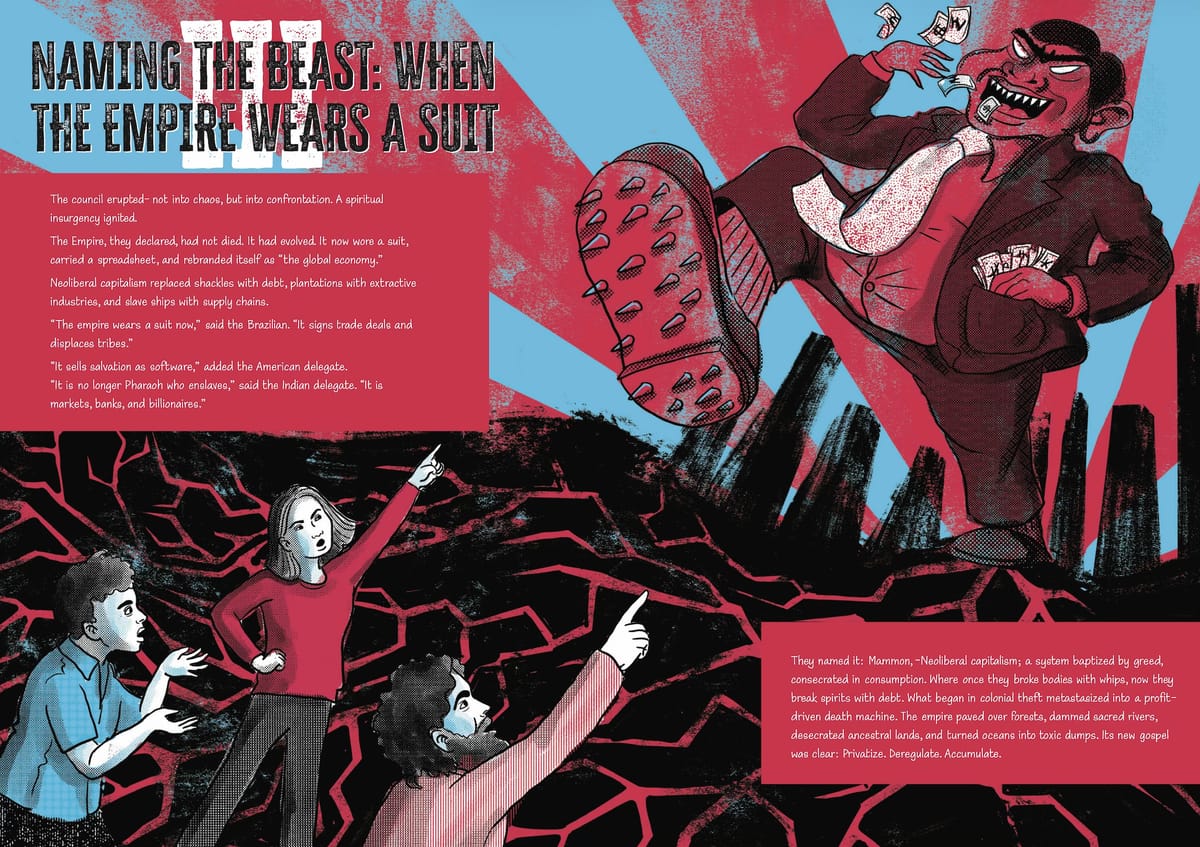
In paragraph 9 the confession outlines the logic of neoliberalism: belief in unrestrained competition, privatization, and the subordination of social obligations to capital accumulation. The next paragraph identifies this as an “ideology that claims to be without alternative,” demanding “an endless flow of sacrifices from the poor and creation,” a system that “claims sovereignty over life and demands total allegiance which amounts to idolatry” (¶10). The authors call this claim idolatrous because it usurps God’s role as giver of life. The biblical analogy is direct: neoliberalism functions as a contemporary manifestation of Mammon (¶14).
The term empire appears in paragraph 11 and is defined as “the coming together of economic, cultural, political and military power that constitutes a system of domination led by powerful nations to protect and defend their own interests” (¶11). This concept allows the confession to interpret international finance, trade institutions, and military alliances as convergent forces within a single moral crisis. The analysis is not abstract. It names the International Monetary Fund, World Bank, and World Trade Organization as participants in this system, describing how “the government of the United States of America and its allies … use political, economic or military alliances to protect and advance the interest of capital owners” (¶13). The confession therefore interprets global governance through the lens of biblical prophecy rather than political science.
Confession of Faith
The second half of the document moves from diagnosis to confession. Paragraph 15 clarifies that the term “confession” does not refer to a new creed but to “the necessity and urgency of an active response” (¶15). The act of confessing becomes a mode of public discipleship. Paragraph 16 announces that “global economic justice is essential to the integrity of our faith in God and our discipleship as Christians” (¶16). The statement joins theology and economics in a single field of responsibility. To ignore economic suffering would be to deny the truth of the gospel.
The confession begins its affirmations in paragraph 17: “We believe in God, Creator and Sustainer of all life, who calls us as partners in the creation and redemption of the world” (¶17). The emphasis on partnership draws upon Reformed understandings of stewardship and covenant. The next affirmation extends this principle to the entire created order: “We believe that God is sovereign over all creation. ‘The earth is the Lord’s and the fullness thereof’” (¶18). The subsequent rejection flows directly from this claim: “We reject the current world economic order imposed by global neoliberal capitalism … which defy God’s covenant by excluding the poor, the vulnerable and the whole of creation from the fullness of life” (¶19).
The confession reads covenant as the foundation of justice. Paragraph 20 declares that “God has made a covenant with all of creation,” describing it as “an economy of grace for the household of all of creation” (¶20). This language redefines economy as the management of divine generosity. The paragraph continues with an appeal to Jesus’ teaching that the poor and marginalized are “preferential partners,” locating solidarity with the oppressed at the center of the community of life. This covenantal vision grounds the repeated refrain, “Therefore we reject.” The church rejects “the culture of rampant consumerism and the competitive greed and selfishness of the neoliberal global market system” (¶21). It rejects “the unregulated accumulation of wealth and limitless growth that has already cost the lives of millions and destroyed much of God’s creation” (¶23). It rejects “any ideology or economic regime that puts profits before people” (¶25) and “any theology that claims that God is only with the rich” (¶27).
The confession’s rhythm alternates between affirmation and renunciation, confession and repentance. It asserts that “God is a God of justice” (¶24), “calls us to stand with those who are victims of injustice” (¶26), and “calls us to hear the cries of the poor and the groaning of creation” (¶28). Each claim returns to a biblical witness: Micah 6:8, Amos 5:24, Luke 4:18, and John 10:10. These references locate the church’s moral imagination within the prophetic and gospel traditions. The confession portrays Jesus as the embodiment of divine justice who “brings justice to the oppressed and gives bread to the hungry” (¶28).
In paragraph 33 the council pledges “to seek a global covenant for justice in the economy and the earth in the household of God” (¶33). This covenant includes confession of sin. The churches admit that they “have become captivated by the culture of consumerism and the competitive greed and selfishness of the current economic system” (¶34). They also confess failure in stewardship and unity. The confession names this as spiritual corruption, not merely moral weakness. It concludes the section with a statement of obedience: “We believe in obedience to Jesus Christ, that the church is called to confess, witness and act, even though the authorities and human law might forbid them” (¶35).
Covenanting for Justice
The closing section transforms confession into covenant. The act of speaking faith together becomes a social bond. Paragraph 37 states, “By confessing our faith together, we covenant in obedience to God’s will as an act of faithfulness in mutual solidarity and in accountable relationships” (¶37). The wording recalls older Reformed ideas of covenant community while adapting them to a global setting. The covenant binds regional and local churches “to work for justice in the economy and the earth.”
The council recognizes that churches stand at different stages of participation. Some “have already expressed their commitment in a confession of faith” while others “are still in the process of recognition” (¶38). The confession invites each body to deepen its engagement through “education, confession and action.” These verbs describe a continuing pattern of discipleship rather than a single event. The following paragraph assigns responsibility: “The General Council calls upon member churches … to undertake the difficult and prophetic task of interpreting this confession to their local congregations” (¶39). The interpretation of doctrine thus becomes a matter of pastoral imagination.
The council then urges practical steps by invoking recommendations on “economic justice and ecological issues” (¶40). It also extends the covenant beyond denominational lines. The confession commits WARC “to work together with other communions, the ecumenical community, the community of other faiths, civil movements and people’s movements for a just economy and the integrity of creation” (¶41). The vision is cooperative rather than competitive, seeking allies in the restoration of the earth.
The final sentence adopts the tone of a vow: “Now we proclaim with passion that we will commit ourselves, our time and our energy to changing, renewing and restoring the economy and the earth, choosing life, so that we and our descendants might live” (¶42). The quotation from Deuteronomy 30:19 situates this pledge within the biblical drama of covenantal choice. The confession closes with resolve, presenting the work of justice and care for creation as the continuation of faith itself.
Faith as Resistance
The Accra Confession joins theology and history in a single moral argument. It reads economic globalization as a site where faith must speak with clarity. It names empire as a spiritual captivity and covenant as a path toward renewal. It acknowledges complicity and appeals to divine grace. It remembers the dungeons of Elmina as a warning against divided faith and interprets the cry of the earth as the groaning of creation awaiting liberation (¶3, ¶5).
Within the history of Reformed Christianity, this confession stands as a landmark. It extends the Reformation’s concern for God’s sovereignty into the field of global ethics. It treats justice as an article of faith rather than a matter of policy. It speaks from Ghana to the world, locating theology in the soil of historical suffering and environmental peril. Its words echo beyond the council that produced them: “We believe that justice shall prevail and peace shall reign” (¶32). The statement does not describe a distant hope. It declares a present calling sustained by the promise of life in fullness.
Resources
- Read the text of the Accra Confession here.


Comments ()