Against the Dignity of Negation
Karl Barth, Das Nichtige, and Anselm Kiefer’s "Sulamith"

[The Nothingness] is the antithesis which is only comprehensible in correlation with creation not as an equilibrating but an absolute and uncompromising No. For it is in opposition primarily and supremely to God Himself, and therefore necessarily and irrevocably to all His work and creation. – Karl Barth1
Das Nichtige
I have been thinking about Karl Barth’s account of “Nothingness” (das Nichtige) and what it would mean to “fight” against it. It’s likely that Barth would have cautioned against a picture of a fair contest between two competing sovereignties. Nothingness, for him, is not a “second principle” standing alongside God. It is rather the destructive negation that God has placed under judgment, even as it still presses on creaturely life.2 That would have to mean that the first act of resistance to Nothingness is conceptual: refusing to treat Nothingness as worthy of fascination.
Let us address these ideas slowly. Barth sharpens the question of “fighting” Nothingness in CD III/3 by refusing to treat it as a rival to God. The Nothingness is the destructive pressure that has no independent right to exist, and, therefore, no claim to awe. Nothingness can only be spoken of as what God has rejected. That rejection, in Barth’s account, is concentrated in Jesus Christ. In Christ, it is God who acts against negation. God bears its assaults and also exposes its pretensions as precisely just that, pretensions. This is why Barth can speak seriously about the way Nothingness still presses on creaturely life, showing up as the slow erosion of confidence in God. The pressure is very real; the status of this pressure is not. Negation does not get to name the truth of the world.
Once Christ’s victory is taken as the starting point, (our) resistance starts to look different. Our task is to live as though God’s decisive verdict has already been spoken, and to refuse the subtle invitation to interpret one’s life as if the verdict were still in doubt. Prayer belongs here as the most basic act of resistance, since prayer is the creature’s refusal to let experience close in on itself. To pray is to hand fear back to its true judge. We must ask that what is already true in Christ become effective in the particular day one is actually living.
This is also where ethics becomes like witness. Resistance looks like staying with one’s vocation under grace and doing the next commanded good without letting Nothingness set the agenda. It can look like telling the truth when distortion feels safer. It looks like choosing concrete acts of mercy when the easier path is indifference. These actions do not “win” in the way the imagination of a fair contest wants to win. But they do make visible that Nothingness lacks authority, even when it remains noisy.
Suffering is often the point at which Nothingness tries hardest to present itself as final. Barth’s framing helps here, because it makes room for lament without turning lament into despair. Lament is not a failure of faith. It is faith refusing to lie about what negation does, while also refusing to grant negation the last word. The last word, on Barth’s terms, belongs to the resurrection of Jesus Christ, which does not erase the wounds of creaturely life, but relocates them within a history God has claimed for reconciliation.
To “fight” against Nothingness can name a steady refusal to grant Nothingness the dignity of fascination, joined to a steady turning toward the God who has already judged it in Christ. The struggle is real, and it is not symmetrical. It is the creature learning to live inside a victory that does not depend on the creature to become true.
Reading Sulamith with Barth
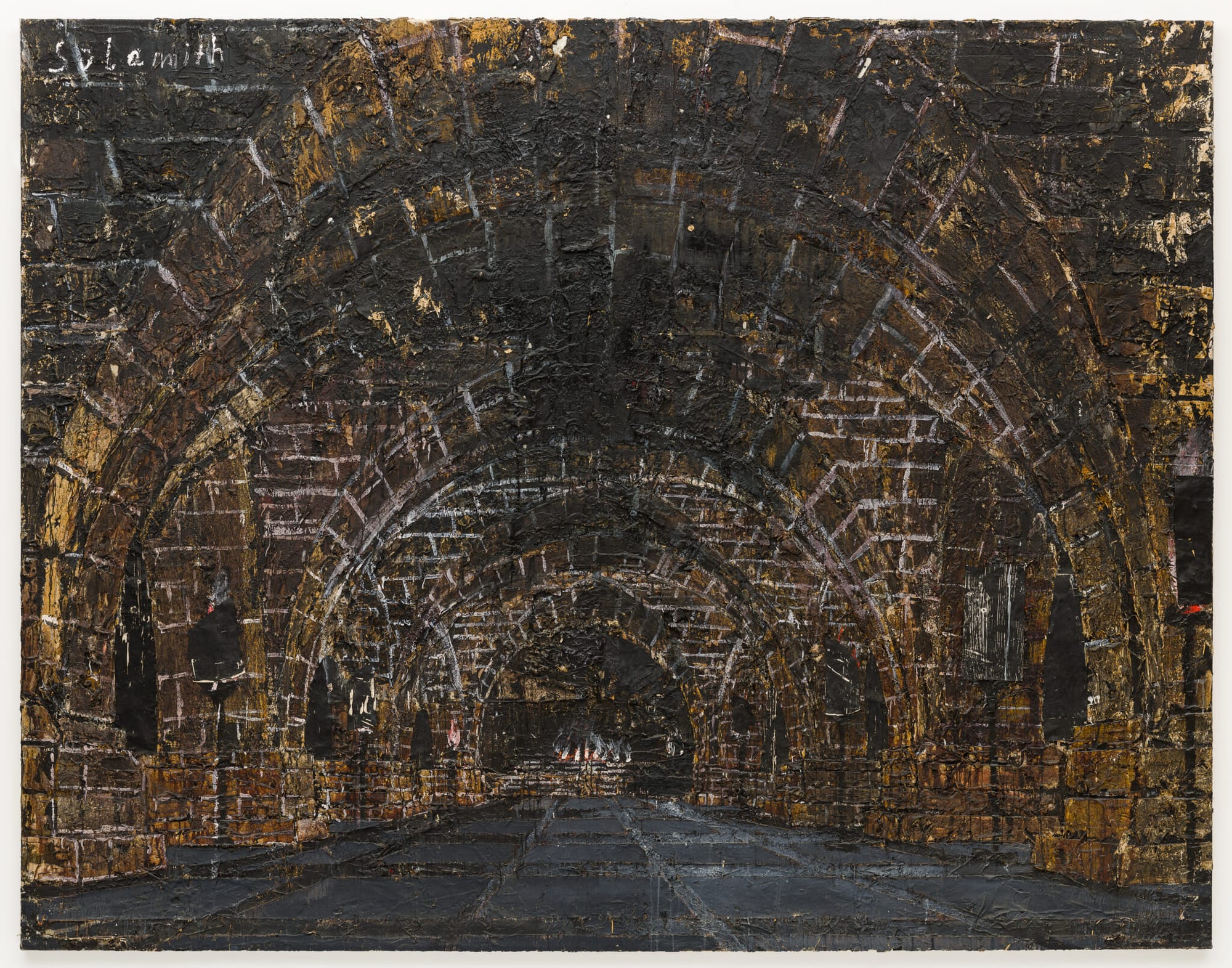
I have also been thinking of Anselm Kiefer’s painting Sulamith (1983)—a monumental mixed-media painting (oil, emulsion, shellac, acrylic paint, woodcut, and straw on linen), roughly 113 1/2 × 146 inches (288.3 × 370.8 cm). It is in the Doris and Donald Fisher Collection at SFMOMA and is regularly exhibited within their post-1960 German art presentation. [See this post’s header image].
Anselm Kiefer was born on March 8, 1945, in Donaueschingen, Germany. He’s a German painter and sculptor, and he’s often seen as one of the major artists to come out of postwar Europe. He came to prominence in the late 1960s and is usually linked to Neo-Expressionism. Much of his work is huge in scale. He returns again and again to Germany’s twentieth-century history, especially the Holocaust, and he uses that history to ask bigger questions about memory.
The painting stages a cavernous, arched interior rendered as scorched masonry. The perspective drives the eye down a central “road” into a dark recess, with a small, distant flare that reads as firelight. Thick impasto and embedded matter make the painting feel like residue – of something, from something. Kiefer’s use of straw and ash rework a Nazi memorial hall in Berlin, presenting it as a foreboding passage that evokes the crematoria’s industrialized killing.
The painting’s title binds the work to Paul Celan’s “Todesfuge” (“Death Fugue”), with its paired figures:
your golden hair Margarete / your ashen hair Sulamith.
Scholars gloss this pairing as a contrast between an idealized German womanhood and Jewish womanhood, with Sulamith also anchored in the Song of Songs tradition. In that frame, Kiefer’s work converts architecture designed for heroic commemoration into an accusatory memorial for victims, including the named Jewish figure whose presence is reduced to ash.
I don’t think that “nothingness” in Barth indicates a psychological mood. As I discussed above, it names evil’s peculiar “reality” as an alien factor that has no proper ontological standing alongside God and creature, yet presses upon creaturely existence as threat. Barth’s translators and commentators underline that the English “nothingness” is a concession, and that Barth intends a very specific sense of “that which is not,” defined by God’s rejection and opposition rather than by abstract negation.
It would be quite easy to absorb Kiefer’s painting into a generic rhetoric of darkness, but Barth’s account does not permit that absorption. Nothingness is “nothing” because its “is-ness” is “objectionable”: only God and God’s creatures properly “are.” Barth still insists on taking it with full seriousness, precisely because God takes it seriously in Jesus Christ and contends against it. Knowledge of it is therefore derivative, not the product of unaided observation. What, in this painting, presents evil as parasitic and accusatory, rather than as a “second principle” alongside God or some deep metaphysical truth?
Nothingness is not “matter,” it is not a mere lack. It is an active contradiction of God’s “Yes” to creation, the object of God’s “No,” and therefore marked by hostility toward creaturely life and fellowship. In my reading, Kiefer’s hall functions like the spatialization of that hostility: it offers no “world” in which ordinary action could unfold. Kiefer’s painting offers a disciplined vanishing point. Reading the painting with Barth, this coercive narrowing is one way to picture evil’s “resistance”: it devours. The corridor depicts a regime that organizes space itself toward death.
Nothingness has no proper self-subsistence. Its peculiar existence is tethered to God’s holiness and election, to the divine demarcation between what God wills and what God does not will. Sulamith refuses to present evil as a natural depth. Evil is a historical construction—a humanly inhabited form of “organized negation.” The hall’s power is recognizable as a power of administration. That recognition is compatible with Barth’s insistence that evil is not something to be granted explanatory dignity.
The painting’s inscription offers us more to consider. “Sulamith” is written in the upper left, rendered as a graffiti-like mark on stone. I read this as testimony to the Jewish figure invoked through Celan and to her death within a chamber “such as this.” One of the chronic temptations in the doctrine of evil is to redescribe evil as necessity, or, even worse, as a determination of God. The painting’s inscription resists this by refusing to let the Nazi hall remain an anonymous sublime. It insists that the space is a space of victims, and that the victim can be named. This is analogous to Barth’s own refusal to grant evil a coherent metaphysical account. Evil can be identified, yes. Evil can be denounced, as it ought to be. But evil cannot be legitimized by explanation.
Barth takes Genesis 1:2 as a scriptural pointer to chaos as an “unwilled and uncreated” reality at the periphery of creation, associated with darkness and “the deep,” a reality that God rejects prior to the first creative word, “Let there be light.” Sulamith is saturated with that Genesis imagery, translated into modern history. I read the hall as a manufactured “deep,” a darkness that has been architecturally stabilized. The painting stages a historical parable of what it would mean for the rejected possibility to press back into the realm of the willed. Barth links that pressure to the creature’s ongoing encounter with Nothingness and to the way sin registers its persisting menace. The hall’s emptiness is therefore not really empty at all. The gas chambers are the visible remainder of a negation that has already acted.
Before we move to Barth’s overflowing optimism (or even Moltmann’s “theology of hope”), we must propose that Nothingness is to be faced as horror and resisted as contradiction of God’s will, without being converted into a meaningful chapter within providential narration. Sulamith becomes a concrete image of evil’s form: a world ordered to consume, and a name that refuses to be consumed.
Karl Barth, Church Dogmatics, III/3, 302–303. ↩
I am glossing “destructive negation” here in a Barthian key, not a critical-theoretical one. I am using it to name what Barth calls das Nichtige in CD III/3, §50, “God and Nothingness” (Gott und das Nichtige), namely a real but illegitimate power of ruin that threatens creaturely life (a “danger” and “menace”), yet is not a second metaphysical principle, not a necessary dialectical counterpart to God, and not a neutral structure of difference or a productive negativity. In other words, “negation” is not being used in the sense common to Hegelian or post-Hegelian critical theory (as the motor of conceptual movement or emancipatory determinate negation), nor in the sense of deconstructive “negativity” as an interpretive strategy. My invocation of “destructive negation” designates, instead, a hostile, disordering contradiction of God’s creative “Yes,” a parasitic force whose reality is grasped precisely as what God has rejected and judged, even while it still “presses on” creaturely history and experience. See footnote 1, above, and, for a careful recent discussion that emphasizes Barth’s understanding of das Nichtige as an “aggressive” destructive force rather than an abstract non-being, see Matthias D. Wüthrich, “An Entirely Different ‘Theodicy’. Karl Barth’s Interpretation of Human Suffering in the Context of his Doctrine of das Nichtige,” International Journal of Systematic Theology 23, no. 4 (October 2021): 593–616. ↩